
Preventing Lameness in Horses: The Role of Muscle Health and Bodywork
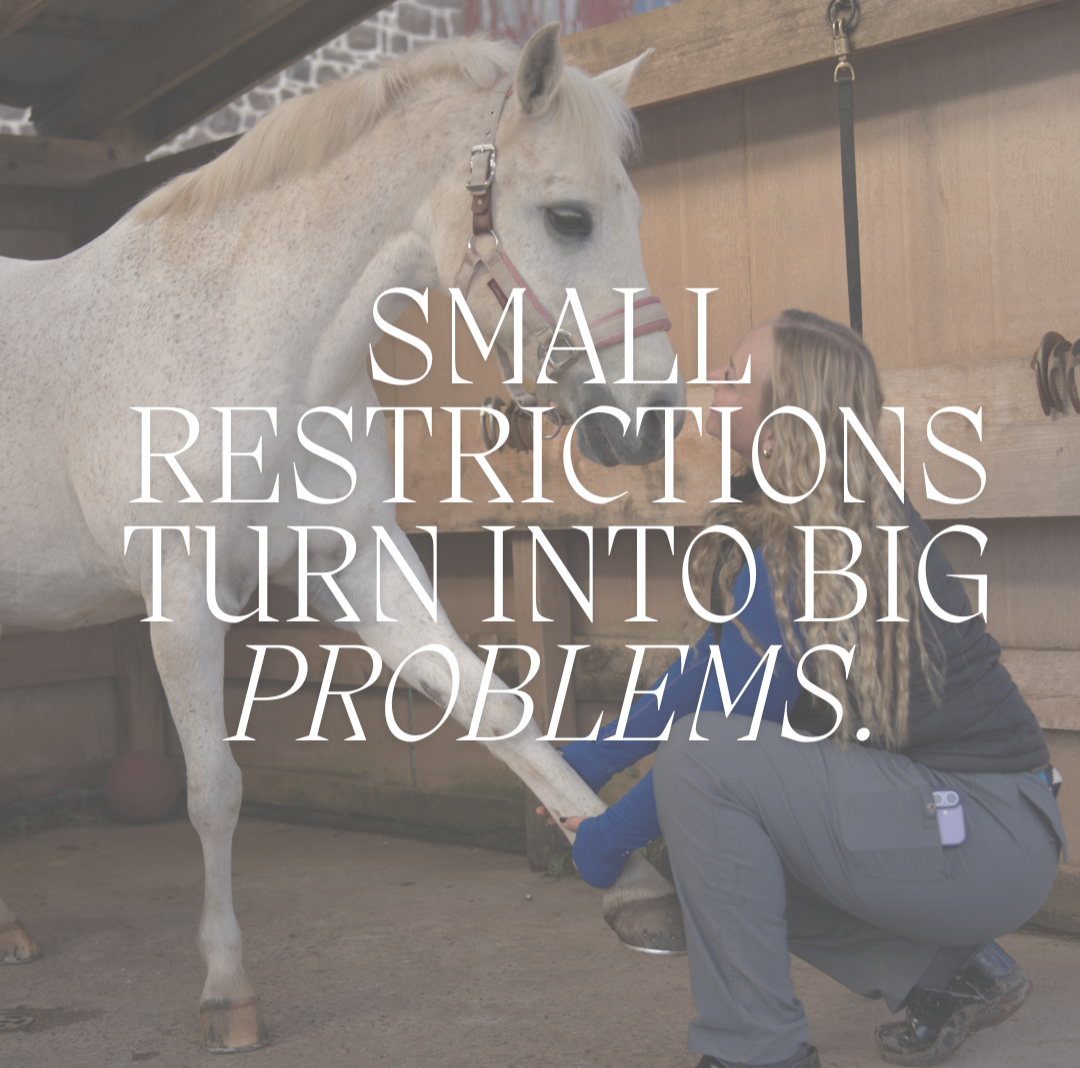
Why Early Muscular Restrictions Matter in Horses
Many horses do not go from “sound” to “lame” overnight.
In most cases, the process is gradual. Small physical restrictions, subtle muscle tension, or minor changes in movement patterns that slowly develop over time. These changes often go unnoticed in the early stages because horses are extremely good at compensating for discomfort.
Research in equine biomechanics and veterinary sports medicine shows that these small restrictions can eventually lead to larger performance issues, chronic pain, or injury if they are not addressed early.
Understanding how and why this happens can help horse owners take a more proactive approach to maintaining their horse’s soundness and long-term comfort.
Horses Are Masters of Compensation
One of the most important concepts in equine biomechanics is compensation.
When a horse experiences discomfort or restriction in one area of the body, it will instinctively adjust how it moves to compensate and protect that strained area. This allows the horse to continue functioning, but it often shifts additional stress to other parts of the body. Research examining equine locomotion shows that when a horse develops lameness in one limb, the way weight is distributed across the other limbs changes significantly as the horse attempts to reduce stress on the affected limb.
In other words, the body redistributes weight and workload to avoid pain.
While this helps the horse temporarily cope, it can create a multitude of secondary issues throughout the musculoskeletal system.
Common compensations may include:
• Increased loading on the opposite limb
• Changes in stride length or rhythm
• Reduced engagement of the hindquarters
• Altered posture or back movement
• Muscle tension developing in surrounding areas
Over time, these altered movement patterns can cause stress in muscles, joints, tendons, and ligaments that were not originally injured.
The Impact of Chronic Compensation
When compensatory movement continues for weeks or months, structural changes inevitably begin to occur in the body.
For example, evaluations on horses with chronic lameness has shown measurable changes in the thoracolumbar multifidus muscle, an important stabilizing muscle along the spine. Long-term lameness can alter the structure of these spinal stabilizing muscles, potentially affecting back function and stability.
This highlights an important reality in equine health:
The primary problem is not always where the horse eventually becomes sore or lame.
A horse may begin with a small restriction in the shoulder, for example, but over time develop soreness in the back, opposite limb, or hind end due to compensation.
This is why veterinarians and equine sports medicine professionals emphasize early detection and intervention whenever possible.
Early Signs of Physical Restriction
Many of the earliest warning signs are subtle and easy to overlook.
These signs do not necessarily indicate lameness but may suggest that the horse is experiencing physical restriction or discomfort.
Common early indicators include:
• Difficulty building or maintaining topline
• Shortened stride or uneven movement
• Resistance to bending or lateral work
• Reduced engagement from behind
• Behavioral changes such as tail swishing or pinning ears
• Difficulty picking up certain leads
• Increased stiffness after work
Often, these changes appear gradually and may initially be attributed to training issues or rider influence.
However, they can sometimes reflect underlying muscular tension or restricted movement patterns.
Why Muscle Health Matters for Performance
Muscles play a critical role in stabilizing joints, absorbing impact, and producing movement.
When muscles become tight, fatigued, or dysfunctional, they can:
• Limit joint range of motion
• Reduce efficiency of movement
• Alter biomechanics of the gait
• Increase stress on tendons and ligaments
Over time, this increased mechanical strain may contribute to injury risk.
Equine locomotion studies demonstrate how complex the coordination of muscles and limbs must be to maintain efficient movement during athletic activity. Even small disruptions to this system can affect overall performance and movement quality.
For performance horses especially, maintaining healthy muscle function is an important part of supporting long-term soundness.
The Role of Bodywork in Preventative Care
Bodywork approaches such as massage therapy, PEMF therapy, and cupping are often used to support muscular health and recovery in horses.
These therapies are commonly utilized to help:
• Reduce muscle tension
• Improve circulation
• Support recovery after work
• Maintain normal range of motion
• Address compensatory muscle patterns
By identifying and addressing areas of restriction early, bodywork can help support more balanced movement patterns and overall comfort.
It is important to note that bodywork does not replace veterinary care, but it can be a valuable component of a comprehensive wellness and performance program that may also include veterinary evaluation, proper farriery, conditioning, and training.
A Proactive Approach to Equine Soundness
One of the most effective strategies for maintaining a horse’s soundness is to address small issues before they escalate.
By paying attention to subtle changes in movement, behavior, and muscle tone, horse owners can often intervene earlier and reduce the likelihood of larger problems developing later.
In many cases, the difference between a minor restriction and a significant issue is simply time and compensation.
Small restrictions may seem insignificant at first, but over time they can influence the entire biomechanics of the horse.
And that is why preventative care matters.
Because in horses, small restrictions can turn into big problems.
Sources
Research and veterinary resources supporting the concepts discussed:
• American Association of Equine Practitioners – Educational materials on equine lameness, biomechanics, and musculoskeletal health.
• Hilary Clayton, BVMS, PhD, Dipl. ACVSMR – Leading researcher in equine biomechanics and locomotion.
• Kevin Haussler, DVM, DC, PhD – Research on equine spinal health and musculoskeletal pain.
• Haussler, K. (2009). “Equine Musculoskeletal Disorders and Chiropractic Care.” Veterinary Clinics of North America: Equine Practice.
• Clayton, H. & Hobbs, S. (2017). “The Role of Biomechanics in Equine Locomotion and Performance.” Veterinary Journal.
• Stubbs, N. et al. (2011). Multifidus muscle size changes in horses with back pain. Published research available through PubMed.
• Dyson, S. (2011). Lameness and poor performance in the sport horse. Veterinary Clinics of North America: Equine Practice.
